In a recent survey, 72% of responding healthcare professionals reported that, when they notice that a family or child needs support, they discuss it during the same appointment. At the same time, strong interest in practical guidance points to a need for more support and confidence in these conversations: 91% of those who answered the relevant question considered a brief guide to addressing difficulties quite or very useful. Training drawing on the Finnish Let’s Talk about Children approach is being developed in Estonia to help professionals feel more confident in supporting parents.
What if every parent left an appointment with a family doctor, a family nurse (a nurse working in general practice) or a midwife with a clearer plan and greater confidence to take action to support their family? And what if the healthcare professional felt that their conversation skills had helped the family move forward?
An appointment may involve an adult whose illness leaves their child struggling to understand what is happening at home. Or it may involve a child whose difficulties affect a parent’s sleep, work and the whole family’s daily life. In both cases, attention needs to be paid to how the family is coping as a whole. The aim is to recognise potential vulnerabilities early and find ways to prevent problems or stop difficulties from escalating.
For example, a parent with depression may come to see their family doctor. Alongside discussing treatment and how the parent is coping, the doctor can ask: “What changes have your children noticed in how you’ve been feeling?” or “What helps your children carry on with their usual lives at the moment?” This may reveal that the child has a supportive grandparent and a hobby or organised activity that matters to them, while the parent needs help to explain their illness in an age-appropriate way. The conversation does not assume that the child already has a problem; it helps identify existing protective factors and choose one manageable next step.
International research helps explain why this kind of conversation matters. A review of studies on mental disorders in parents found that children often do not understand what is happening to their parent and experience confusion, fear or guilt. A review in The Lancet of families in which a parent has a life-threatening illness highlighted that children often sense when something is seriously wrong, while parents may worry about how talking about the illness will affect their child. Healthcare professionals can help parents explain what is happening and respond to their children’s questions.
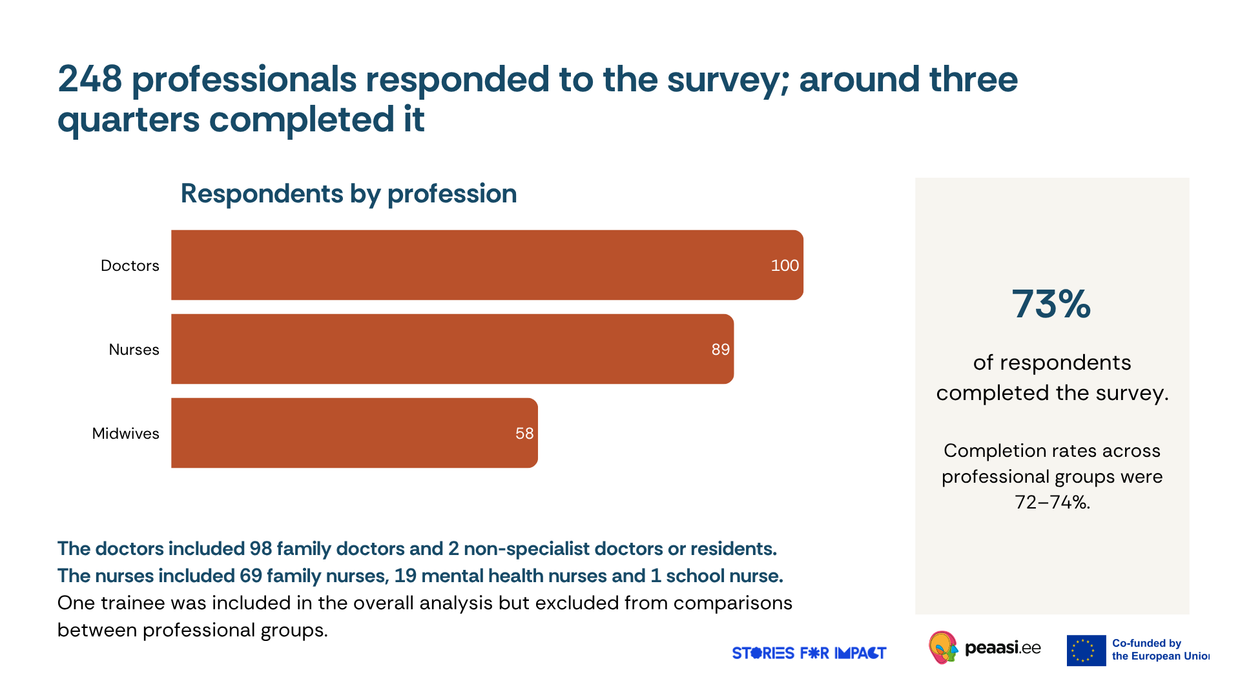
In early autumn 2026, we analysed responses from 248 healthcare professionals to an online survey conducted as part of the Erasmus+ project “Children & Family Mental Well-being in Healthcare”. The survey was distributed through professional associations, with the largest numbers of responses coming from Harju and Tartu counties in Estonia.
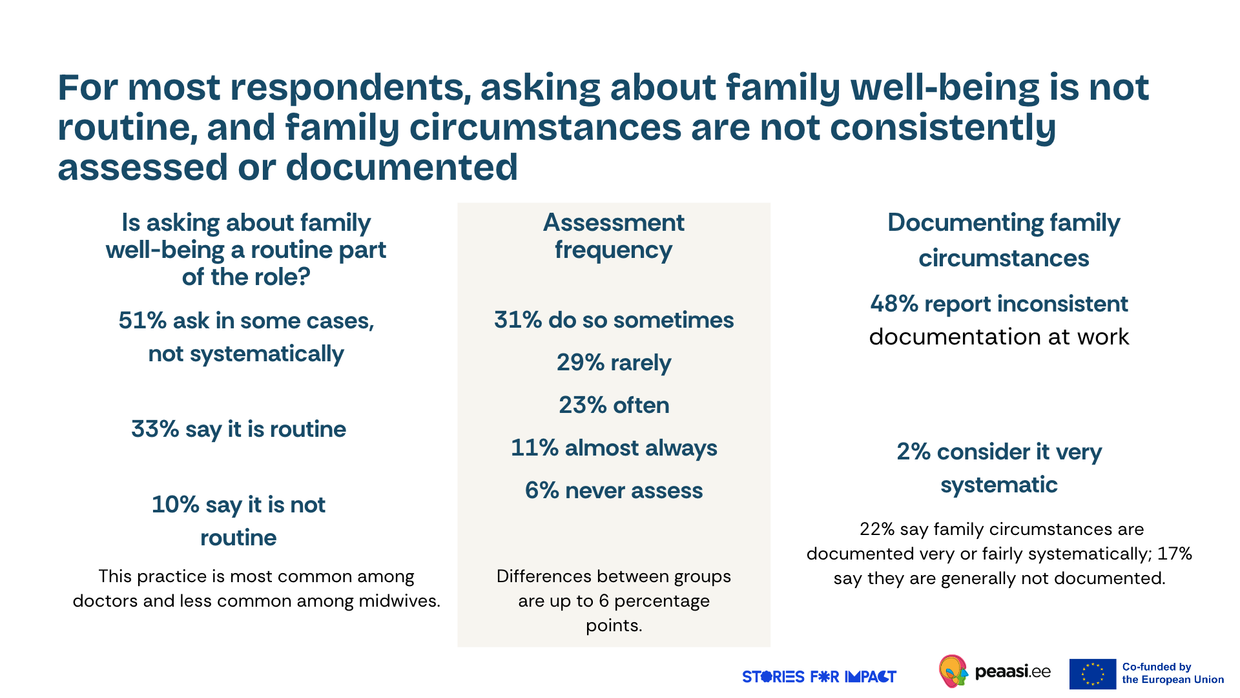
Asking about the family’s situation was a routine part of work for 33% of respondents, while 51% asked in some cases. When they notice that a family or child needs support, 72% of respondents reported that they discuss it during the same appointment. However, respondents felt less confident about starting the conversation and recommending next steps than they did about recognising a need for support.

For example, one midwife explained that patients do not always want to talk about difficulties within their family and expressed a wish to learn how to handle sensitive conversations. Among those who answered the question about practical tools, 89% considered a brief guide on when to ask about family well-being quite or very useful. The corresponding figures were 91% for a brief guide to addressing difficulties and 77% for an example of how to structure the conversation.
The survey points to two connected needs: healthcare professionals want to feel confident discussing difficult issues with families, and they want clarity about what an appropriate next step might be. Both are being addressed through the project. Practical tools to support conversations, together with training, are being developed in collaboration with representatives of the Estonian Society of Family Doctors, the Estonian Midwives Association and the Estonian Nurses Union. The project is also working to clarify possible pathways to support for families.
Simply asking professionals to pay more attention to families’ needs is, of course, not enough. One nurse described the expectation that a family nurse should see patients for five hours a day and then respond to phone calls and emails. In their view, this workload does not allow for high-quality care. Particular care must be taken to avoid the situation one respondent feared: a complicated, time-consuming guide to talking with families could create yet another unfinished task and a sense of guilt. The aim is therefore to give professionals simple ways to use existing contact with patients to support family well-being.
After discussing the family’s situation, additional support may be needed. A clearer pathway to support would help families access it: 95% of those who answered the relevant question considered this quite or very useful. For a family, this means understanding what kind of help suits their needs and how to access it. There are many options between self-help and psychiatric care, such as counselling from a family nurse, support to develop parenting skills, or finding a suitable hobby or organised activity for a child in the local community. Collaboration with school health and occupational health services is also possible, with specialist healthcare involved when necessary.
One doctor wanted a named contact to whom they could pass information quickly and easily when a concern arose. A midwife described an arrangement that was already working: a hospital social worker liaises with the relevant professionals and reports back to the midwife. Establishing such arrangements requires cooperation between organisations.
Healthcare professionals can start a conversation that helps a parent make sense of their family’s situation. They can explain why they are raising the subject, listen before offering advice and explore what is already working well in the family. The parent can reflect on what their child knows or senses about the situation and choose a manageable next step. This might mean explaining what is happening or maintaining a daily routine that matters to the child. The aim is to support parents in taking action themselves and give professionals the experience of seeing their skills make a difference. This can strengthen both their confidence and their trust in one another.
This way of thinking underpins Let’s Talk about Children, an approach developed in Finland that originated in psychiatry. It centres on looking at a child’s everyday life as a whole: what supports them, where vulnerabilities may lie, and what parents and other important adults can do to sustain their well-being. Parents are the experts on their family’s daily life; professionals help them recognise strengths and identify next steps. The effects of the structured Let’s Talk about Children discussion method have been studied, including in families in which a parent has a mental disorder. The primary care training draws mainly on the approach’s underlying mindset and principles for conversations, rather than teaching professionals to deliver the full structured intervention.
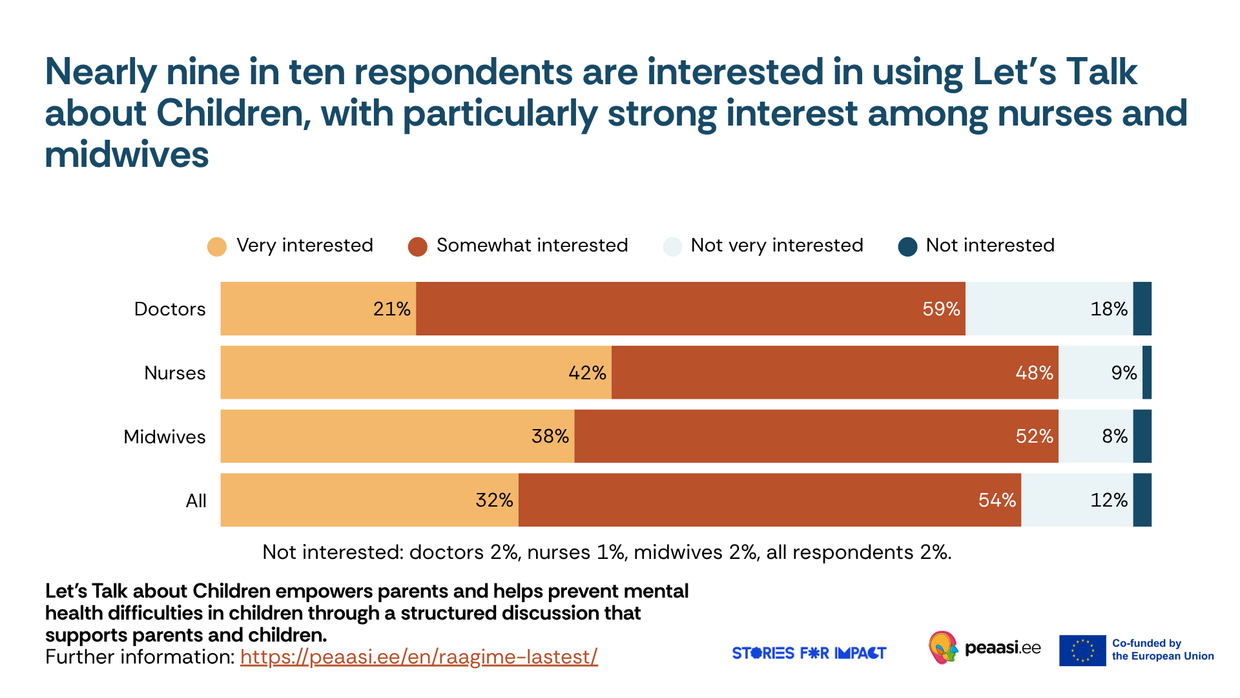
Drawing on the Let’s Talk about Children approach, practical training is being developed in Estonia for family doctors, family nurses and midwives to strengthen their skills in talking with parents and empowering them to act. The first course will run in the first quarter of 2027. Peaasjad, an Estonian mental health NGO, and Stories For Impact are developing the training with partners in Finland and Italy as part of the ongoing Erasmus+ project. In Italy, the training focuses on supporting families in oncology and intensive care units. In both Estonia and Italy, participants will practise recognising families’ difficulties and resources, discussing these with parents, and empowering parents to take realistic next steps.
Alongside the training, the project is examining what support families can access through healthcare, social services and the community when needed, and how professionals can navigate these options.
To put a preventive approach and practical skills to use, professionals need clear working arrangements and support from managers. One midwife emphasised in the survey that these conversations must be built into routine working arrangements. For a family-centred approach to work, teams need to agree on who will talk with families and when, how time can be made available, and how staff can practise what they have learnt. It is also important to discuss experiences, including through professional supervision where needed. This allows professionals to use their skills in a supportive environment and helps parents take a step that matters to their family before difficulties escalate.
We should not wait until a child develops difficulties before paying attention to their well-being. An appointment between a parent and a family doctor, family nurse or midwife can offer a valuable opportunity for prevention, provided the professional has the skills to use it, clear next steps to offer and the necessary organisational support.
This article was first published in Estonian by Meditsiiniuudised, an Estonian medical news outlet.